Palantir
Updated: Aug 10
Palantir Technologies — Overview
Palantir is a data-analytics and AI software company founded in 2003, originally built for U.S. intelligence and counterterrorism work before expanding into commercial enterprise markets. Its core pitch: help large, complex organizations integrate messy, siloed data and turn it into operational decisions, not just dashboards, but software that can trigger real-world actions.
Palantir organizes its offering around four principal software platforms: Gotham, Foundry, Apollo, and AIP (Artificial Intelligence Platform).
Palantir Main Products
Gotham — Palantir's flagship platform, designed for intelligence, defense, and law enforcement use, integrating vast sets of data to detect patterns, identify threats, and derive actionable insights. Originally built for counterterrorism and military missions, it's now used broadly across allied defense and intelligence operations.
Example use cases: battlefield command and situational awareness (used at U.S. Army command posts), intelligence pattern-of-life analysis, disaster relief coordination, fraud/threat detection for government agencies.
Foundry — The foundational data operations platform, providing core capabilities for data management, logic authoring, Ontology development, analytics, and workflow development. This is Palantir's commercial-enterprise product, and its central concept is the Ontology — a semantic layer that maps how an organization's data, logic, and real-world objects/actions relate to one another, so different systems can "speak the same language."
Adopted across health care, manufacturing, energy, and finance for things like supply chain management, risk forecasting, and quality assurance.
Apollo — The continuous delivery platform that manages the underlying infrastructure hosting both Foundry and AIP services, enabling orchestration of zero-downtime upgrades across hundreds of services and assets every day. It's largely invisible to end users but critical for deploying software into disconnected, classified, or highly regulated environments (submarines, forward operating bases, air-gapped networks).
Example use case: pushing updated threat libraries to Navy systems automatically when a submarine docks and reconnects to a network.
AIP (Artificial Intelligence Platform) — The generative AI platform, providing secure connectivity to large language models through the "k-LLM" paradigm, a development toolchain for building agents and automations, AI-enabled end-user applications, and a comprehensive Evals framework for governing AI workflows in production. AIP sits on top of the Ontology, meaning any agent it builds can reason over an organization's real, governed data rather than a generic knowledge base, with audit trails, access controls, and human-in-the-loop checkpoints layered in.
Example use case: an AIP-built agent that reads incoming logistics data, drafts a supply reallocation plan grounded in the Ontology, and routes it for human sign-off before execution, with every step logged for auditability.
How they fit together
Foundry and Gotham are the two "front-end" platforms end users actually work in (commercial vs. defense/intel, respectively), both built on the shared Ontology. AIP is the AI/agent layer that runs on top of that Ontology in either environment. Apollo is the plumbing underneath all of it, handling deployment and updates, including into disconnected or classified settings where normal cloud deployment doesn't work.
One useful mental model: Foundry/Gotham = what the organization's data and logic mean; AIP = what an AI agent can do with that meaning; Apollo = how any of this software actually gets shipped and kept current, everywhere from a laptop to a submarine.
Palantir Foundry
Foundry's whole design can be understood as a pipeline: raw data comes in one end, and by the time it comes out the other end, an ordinary business user is clicking on it in a dashboard without ever seeing a database or a line of code. The three core applications: Pipeline Builder, Ontology, and Workshop, are the three stages of that journey, and the five processes (Ingest → Transform → Publish → Enrich → Consume) map cleanly onto them.
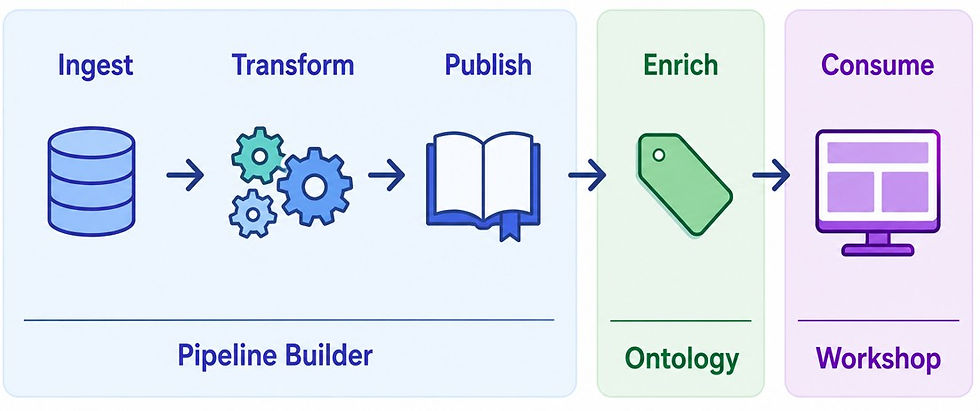
1. Pipeline Builder — "Get the data in and make it clean"
Pipeline Builder is Foundry's data-engineering workspace: a largely no-code/low-code visual tool for building data pipelines. It owns the first three processes.
2. Ontology — "Give the data meaning"
The Ontology is Foundry's semantic layer, arguably its most distinctive concept. It takes the clean data published by Pipeline Builder and turns it into objects, properties, links, and actions that represent real-world things (a flight, a customer, a piece of equipment, an employee) rather than raw rows and columns. This is what lets a non-technical business user talk about "the flight that's delayed" instead of "row 4,502 in table X."
3. Workshop — "Let people actually use it"
Workshop is Foundry's low-code application-building tool for end users. It's where the enriched Ontology becomes something a decision-maker interacts with directly.
The throughline is that each stage reduces technical complexity for the next person down the chain: data engineers wrestle with raw sources in Pipeline Builder, so that Ontology modelers can define clean business concepts, so that non-technical end users in Workshop can just click buttons and read dashboards, while full lineage and audit trail is preserved all the way back to the original raw ingest.
Ingest
Foundry's philosophy is that data should be ingested "as-is" from its most raw source, with no external preprocessing. This matters because it preserves full lineage back to the original source, nothing is silently cleaned or reshaped before Foundry has a record of it. Ingestion connects to structured, semi-structured, and unstructured sources (databases, S3 buckets, APIs, scanned PDFs, flat files) using batch, micro-batch, or streaming methods, and can also use virtual tables, pointers to external system tables that let you reference data without physically copying it into Foundry.

Transform
This is where raw data actually gets shaped: cleaned, joined, standardized, aggregated, or reformatted. Foundry provides an extensible, scalable "Build" framework that supports multiple compute runtimes under the hood, and Pipeline Builder gives data engineers no-code transform nodes (or code, via Code Repositories) to do things like standardize inconsistent formats, deduplicate records, or even run LLM-based operations (e.g., translation) as part of the pipeline. Every transform is tracked for full data lineage and quality checks, you can always trace an output value back to the exact upstream rows and logic that produced it.

Publish
Once a pipeline runs, its outputs are "published" as one of three things: a clean dataset, a virtual table, or, critically. an Ontology object (object type, link, or time series). This last option is the bridge into the next core area: Pipeline Builder lets you define Ontology elements directly from within the same pipeline workflow, rather than jumping to a separate tool.
Example: An airline ingests a raw Oracle flight-ops CSV export, nested JSON booking records from an OTA system, and scanned PDF maintenance logs. Pipeline Builder transforms and cleans each of these separately, then publishes a unified, structured "Flight" dataset ready to become an Ontology object.

Enrich
This is where the Ontology adds business logic and interconnection on top of the raw structure:
Derived properties — computed fields, e.g., delay_minutes = actual_time − scheduled_time
Cross-object aggregations — e.g., average delay per airline, computed dynamically from linked objects
Links — relationships between object types (a Flight links to its Passengers, its Aircraft, its Airport), which can auto-resolve (foreign-key based) or be built from join tables
Actions — write-back logic that lets a user or an automated process change the state of the real world through the Ontology, e.g., canceling a flight can automatically release seats and trigger passenger notifications
External enrichment — querying live external systems (like a weather API) to enrich objects in real time
The result is an Ontology object that's not just "data" but a living representation of a business entity, with computed properties, relationships to other entities, and defined actions that can be taken on it, all governed and audited.

Consume
This is the final process: building dashboards, operational applications, and interactive tools on top of Ontology objects, without needing to know anything about the pipelines or transforms underneath. A logistics coordinator, an operations manager, or an executive can:
View and filter live Ontology objects (e.g., all currently delayed flights)
Trigger Ontology Actions directly from the UI (e.g., reassign an aircraft, rebook passengers)
Build custom dashboards, forms, and workflows via drag-and-drop widgets
See AIP-powered features layered in (e.g., an AI agent summarizing today's delays) since Workshop and AIP are tightly integrated
Example: The same airline's operations team opens a Workshop app showing real-time flight status. When a flight is flagged as delayed via an enriched property, an operator clicks an Action button to trigger passenger rebooking — a workflow that touches ingested source data, transformed logic, and Ontology-defined actions, all without the operator ever seeing the underlying pipeline.


Comments