CISO MindMap & Maturity - Part 2 - 'Team Management'
One of the first areas of the CISO MindMap we will examine is Team Management, which encompasses both Information Security Budget Management and Staffing and Talent Management.

There is no single, universally adopted “Security Budget Capability Maturity Model” dedicated specifically to IT or information-system security budgeting. However, several established capability maturity models include budgeting, financial governance, or resource optimization as part of broader security or IT-governance maturity, and they are routinely used by enterprises to assess and mature how they plan, allocate, and manage cybersecurity spend. These are often built using components from:
CMMI
COBIT
NIST RMF
ISO 27014
FAIR
Many of these have overlap with the models that relate to security budgeting have overlap with the CISO MindMap areas of Governance and Risk Management.
Organizational-Specific Security Budget Maturity Models (Common in Large Enterprises)
Many organizations create internal maturity models that include stages such as:
Ad-Hoc: Reactive budget requests; no forecasting
Basic: Annual budgeting with minimal risk linkage
Defined: Formal budgeting workflows and cost centers
Managed: Budget tied to risk and performance metrics
Optimized: Quantitative ROI, predictive forecasting, scenario modeling
NIST RMF Cybersecurity Framework (CSF) – Implementation Tiers
NIST CSF does not provide a budget model, but its Implementation Tiers (1–4) directly address: Investment prioritization, Resource allocation processes, Organizational risk appetite alignment, Strategic planning of cybersecurity initiatives. As organizations move from Tier 1 (“Partial”) to Tier 4 (“Adaptive”), they mature in: Budgeting tied to risk, Predictable funding cycles, Governance-aligned financial decision-making
NIST SP 800-55 (Performance Measurement Guide for Information Security)
This framework supports: Budget justification models, Security program measurement,
Resource-driven maturity measurements
Staffing and Talent Management
CMMI People Capability Maturity Model (P-CMM)
PCMM is the most formal and widely recognized maturity model for talent and workforce management. Maturity Levels
Initial – Ad hoc staffing, hero culture, high dependency on individuals
Managed – Basic workforce planning, training, and performance management
Defined – Competency frameworks, standardized career paths, role definitions
Predictable – Quantitative workforce metrics, capacity forecasting
Optimizing – Continuous skills improvement and workforce innovation
NIST NICE Workforce Framework (Role-Based Maturity)
NIST NICE stands for the National Initiative for Cybersecurity Education. While the NICE Framework is not a maturity model by itself, it was developed in response to the growing demand for skilled cybersecurity professionals and the challenges organizations face in consistently defining, measuring, and developing in-demand cyber skills.
The NICE Framework organizes cybersecurity work into a hierarchical structure, beginning with high-level Work Role Categories. Each category is further decomposed into more specific roles and functional areas. For example, within the Protection and Defense (PD) work role category, the framework expands into multiple subareas. Each subarea includes defined Task Statements, Knowledge Statements, and Skill Statements that describe expected activities and competencies.


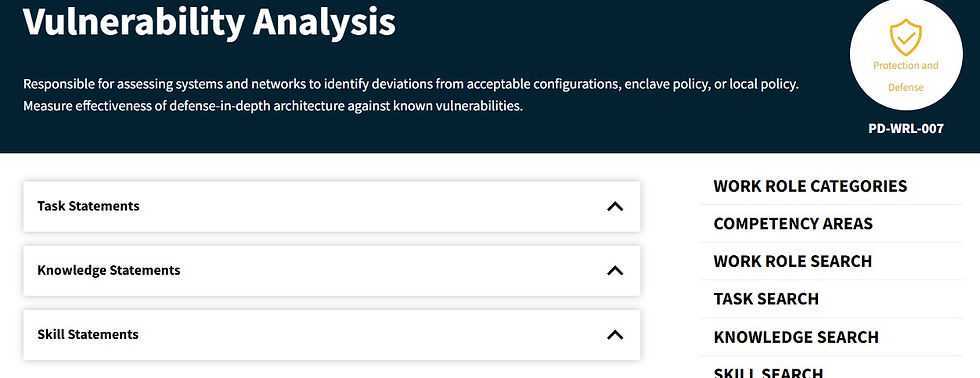
Using Vulnerability Analysis as an example, NICE provides a set of task statements intended to describe the scope of work involved. Practitioners with real-world experience will recognize that these task statements remain intentionally high level, and that significant variation exists in how “skill” is defined and applied across organizations, tools, and environments. However, the framework provides a necessary baseline. A substantial amount of effort went into its development, making NICE a strong starting point for structuring roles and capabilities.

It is important to note that NICE should not be treated as a checklist exercise where boxes are simply checked and workforce maturity is assumed. Instead, it should be used as a foundational reference to support workforce planning, capability mapping, and development.
When applied to staffing and talent management maturity, a “Managed” level often indicates that roles are mapped to the NICE Framework, with initial planning in place for training, skills development, and performance management.
References
NIST SP 800-55v1 Measurement Guide for Information Security Volume 1 — Identifying and Selecting Measures
Measurement Guide for Information Security: Volume 2 — Developing an Information Security Measurement Program
People Capability Maturity Model (P-CMM) Version 2.0, Second Edition
NICE Workforce Framework for Cybersecurity (NICE Framework)


Comments